Why Enterprise AI Projects Fail: The 95% Gap

$37 billion spent on enterprise AI in 2025. A 95% failure rate. Something doesn't add up—and the answer isn't what most companies want to hear.
Key Takeaways
- The 95% Reality: The MIT NANDA Initiative (2025) confirms 95% of enterprise generative AI pilots fail to deliver measurable ROI—this is not an AI quality problem
- Mental Model, Not Tools: The 5% that win treat AI as infrastructure requiring organizational redesign, not a bolt-on feature
- Anthropic Beat OpenAI by Going Enterprise-First: Security, explainability, and workflow fit captured 32% enterprise market share by mid-2025 while OpenAI fell from 50% to 25%
- The Pilot-to-Production Gap Is the Real Killer: 80% of companies cannot scale beyond proof-of-concept—this is now the #1 failure point
- The Playbook Exists: The winning 5% follow a specific 4-step pattern. It's not secret. Most companies just skip the boring parts.
Why Do 95% of Enterprise AI Projects Fail? (The Real Answer)
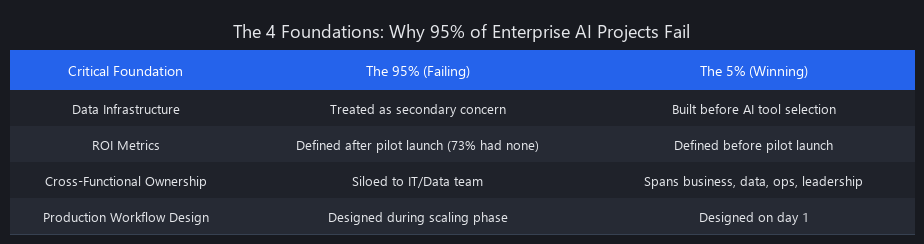
Enterprise AI projects fail because companies treat AI as a technology problem rather than an organizational one. According to the MIT NANDA Initiative (2025), 95% of enterprise generative AI pilots fail to deliver measurable ROI—not because the models are weak, but because the implementation strategy is fundamentally broken. The 95% lack four critical foundations: (1) aligned data infrastructure, (2) clear ROI metrics defined before pilot launch, (3) cross-functional ownership, and (4) a scaled production workflow designed from day one. Winners focus on these organizational prerequisites first. The AI tool is secondary.
Why Enterprise AI Fails: The Pilot-to-Production Gap Nobody's Discussing
Here's the paradox nobody at your last AI offsite mentioned: enterprise companies spent $37 billion on AI in 2025 (Menlo Ventures, 2025), yet the RAND Corporation found that over 80% of AI projects fail outright—twice the failure rate of non-AI IT projects.
The MIT NANDA Initiative (2025) sharpens that number further: 95% of enterprise generative AI pilots fail to deliver measurable ROI. S&P Global Market Intelligence (2025) corroborates this trend: 42% of companies abandoned most of their AI initiatives in 2025, up from just 17% in 2024.
Everyone discusses what AI can do. Nobody performs a forensic breakdown of why it keeps failing. The answer isn't the model. It isn't the vendor. It's the mental model companies bring to the table—and it's wrong in a very specific, correctable way.
The winners aren't using better AI. They're using a different playbook entirely.
The 3 Critical Mistakes That Kill Enterprise AI Projects
Most enterprise AI failures trace back to three compounding mistakes made before a single line of code is written. They're not technical failures. They're strategic ones. Here's the forensic breakdown.
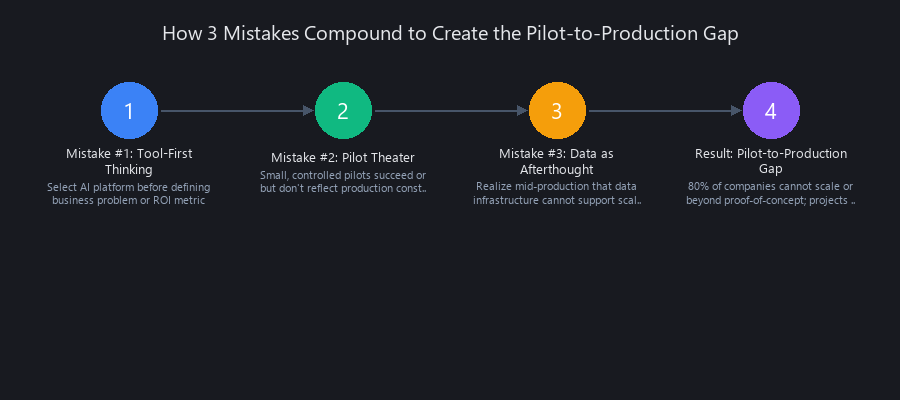
Mistake #1 – Starting With the Tool, Not the Problem
The most common pattern: a company buys ChatGPT Enterprise access in Q1, schedules an "AI brainstorming session" in Q2, and wonders why nothing shipped by Q4.
That's inverted logic. Winners identify a high-ROI problem first—cost reduction, revenue uplift, efficiency gain—before selecting a tool. S&P Global (2025) found that 73% of failed AI projects had no pre-defined success metric at pilot launch. Not a vague goal. Zero defined metric.
Anthropic's enterprise wins are instructive here. Their sales motion doesn't start with "here's what Claude can do." It starts with specific workflows: code generation, document analysis, customer service automation. The tool follows the problem. Every time.
This is the enterprise AI ROI gap explained in one sentence: you can't measure ROI on a solution that was never tied to a problem.
Mistake #2 – Pilot Theater (Success That Doesn't Scale)
Pilots succeed because they're small, controlled, and staffed with your best people. That's not a win. That's a science fair project.
Production fails because the data infrastructure isn't ready, governance is absent, and nobody redesigned the actual workflow. McKinsey (2025) found that only 13% of companies successfully scale AI beyond initial pilots. The pilot-to-production gap is now the #1 failure point in enterprise AI implementation.
The trap is treating pilot success as proof of production readiness. A pilot that works for 50 users with a dedicated ML engineer babysitting it will collapse when you try to run it for 5,000 users across three business units with no dedicated support.
Mistake #3 – Treating Data as an Afterthought
This one hurts to read if you've already launched. 68% of enterprise AI failures trace back to poor data quality or fragmented data infrastructure (Forrester/Capital One, 2024). A 2024 Forrester survey found that 73% of enterprise data leaders named data quality and completeness as the primary barrier to AI success—ranking it above computing costs and model accuracy.
Winners spend 60-70% of their pre-launch effort on data pipelines, governance, and integration. Losers spend 10-20% and then blame the model when outputs are garbage.
Garbage in, garbage out is not a new concept. Yet it remains the leading cause of enterprise AI implementation failure in 2025.
Why Is Anthropic Winning Over OpenAI in Enterprise? (And What It Reveals About the Winning Playbook)
Anthropic captured 32% of the enterprise LLM market by mid-2025, surpassing OpenAI's 25%, by building for enterprise needs first—security, explainability, and workflow fit—rather than consumer scale. This shift is the clearest real-world case study of the winning AI playbook in action. The strategic difference isn't model capability. It's organizational focus.
OpenAI's playbook: Consumer-first, general-purpose, move fast, rely on scale. This worked for ChatGPT's consumer viral moment. It creates friction in enterprise procurement, especially around data governance and security policies.
Anthropic's playbook: Enterprise-first, specialized workflows, security-by-default, explainability built-in. Claude's context window and code-specific training aligned with how enterprises actually use AI: long documents, code review, refactoring, structured data analysis.
Here's the market reality:
| Metric | Anthropic | OpenAI |
|---|---|---|
| Enterprise Market Share (mid-2025) | 32% | 25% |
| Coding Market Share (2025) | 54% | 21% |
| Annualized Revenue (March 2026) | $19B+ | $13.1B (2025) |
| 2025 Net Loss | Not disclosed | ~$8B |
| Primary Market Focus | Enterprise-first | Consumer + Enterprise |
| Data Training Policy | No training on customer data | Consumer-friendly defaults |
Sources: Menlo Ventures (2025), ZDNET (2025), Forbes (2026)
The data security angle is where Anthropic's enterprise strategy becomes undeniable. Harmonic Security (January 2026) analyzed 22.4 million enterprise AI prompts and found that while only 40% of companies purchased official LLM subscriptions, over 90% of employees regularly use personal AI tools for work. That shadow AI problem costs companies an average of $4.63 million per breach (IBM, 2025 Cost of Data Breach Report).
Anthropic's enterprise pitch—"keep your data in your infrastructure, we don't train on your data"—directly solves the problem enterprise security teams are losing sleep over. OpenAI's consumer-friendly defaults create the problem.
That single strategic insight explains most of the market shift.
How Do You Scale AI From Pilot to Production? The 4-Step Playbook
The 5% that succeed at enterprise AI follow a specific sequence: define ROI first, build data infrastructure second, select the right tool third, and design for scale from day one. The 95% skip steps one and two, then wonder why their AI investment isn't working.
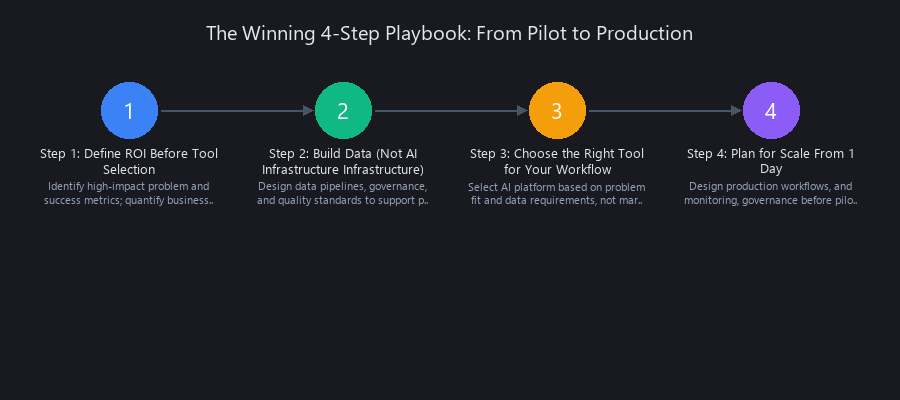
Step 1 – Define ROI Before You Pick a Tool
Identify 1-3 high-impact workflows where AI can measurably reduce cost or increase revenue. Set success metrics before pilot launch, not after.
Good example: "Reduce customer support ticket resolution time by 30% within 90 days."
Bad example: "Explore how AI can improve our operations."
Winners spend 2-3 weeks on this step. Most companies skip it entirely and go straight to vendor demos.
Step 2 – Build Data Infrastructure (Not AI Infrastructure)
Audit your data readiness before touching an LLM. Where is your data? Is it clean? Is it accessible across systems? Does it have governance controls?
Create a single source of truth for training and production data. This step consumes 60% of pre-launch effort for successful deployments. It prevents 80% of production failures. It is also the least glamorous thing you will do in your AI program, which is exactly why the 95% skip it.
Step 3 – Choose the Right Tool for Your Workflow (Not the Hottest Tool)
Once you know your problem and your data, then you select the tool. For coding and long-context document workflows: Anthropic's Claude. For consumer-facing apps with broad general knowledge needs: OpenAI. For tight Google Cloud integration: Gemini.
This decision should take one week, not three months. The analysis is straightforward once steps 1 and 2 are done.
Step 4 – Plan for Scale From Day 1
Design workflows, governance, and infrastructure to support 10x your pilot scale from the start. Assign cross-functional ownership—not a single AI team that becomes a bottleneck.
The pilot-to-production gap exists because pilots are designed as experiments. Production systems need to be designed as products. That requires engineering rigor, change management, and organizational buy-in that no pilot budget includes.
Pre-Launch AI Readiness Checklist (The 5% Use This)
✅ ROI DEFINITION
 □ High-impact workflow identified (specific, not vague)
 □ Success metric defined with baseline measurement
 □ Timeline and budget set before vendor contact

✅ DATA INFRASTRUCTURE
 □ Data sources mapped and audited for quality
 □ Data governance policy in place
 □ Integration architecture designed for production scale
 □ Security and compliance requirements documented

✅ TOOL SELECTION
 □ Tool evaluated against specific workflow requirements
 □ Security/data policy reviewed (especially: does vendor train on your data?)
 □ Enterprise support tier confirmed

✅ SCALE PLANNING
 □ Production architecture designed for 10x pilot scale
 □ Cross-functional ownership assigned
 □ Change management plan in place
 □ Failure/rollback procedures documented
How Much Does Enterprise AI Implementation Actually Cost? (And Why Most Budgets Fail)
Most enterprise AI budgets fail not because companies spend too much, but because they allocate to the wrong categories—heavily over-indexing on tool licenses and under-investing in data infrastructure and talent. Here's what realistic numbers look like:
| Deployment Tier | Scale | Realistic Budget Range |
|---|---|---|
| Small Pilot | 100 users, 3-6 months | $500K – $2M |
| Mid-Scale Deployment | 500-1,000 users | $3M – $8M |
| Enterprise-Wide Rollout | 5,000+ users | $10M – $50M+ |
And here's where the money actually goes in successful deployments:
| Category | % of Budget | What Most Companies Budget |
|---|---|---|
| Data infrastructure & integration | 40-50% | 10-15% |
| AI tool licenses & APIs | 10-15% | 40-50% |
| Talent (data engineers, ML ops, change management) | 25-35% | 20-30% |
| Governance, security, compliance | 10-15% | 5-10% |
The mismatch is the failure mechanism. Companies budget for the tool and starve the infrastructure. Then the infrastructure fails in production and they blame the tool.
The hidden cost of failure compounds this: failed pilots waste 60-70% of budget with zero ROI, demoralize teams, increase turnover, and hand competitors a compounding advantage. Sequoia Capital estimates the AI industry needs $840 billion in end-user revenue to justify current infrastructure build-outs. The window for early movers is real and it is closing.
Key Takeaways – The 5% vs. The 95%
- The Problem Is Organizational, Not Technical: Why enterprise AI projects fail consistently traces back to mental model errors, not model quality. The 95% treat AI as a technology problem; the 5% treat it as an organizational redesign
- Anthropic's Win Is the Clearest Signal: Enterprise market dominance went to the vendor that prioritized security, explainability, and workflow fit—not raw capability
- Follow the Sequence: Define ROI → Build Data Infrastructure → Choose the Right Tool → Plan for Scale. The 95% skip steps 1 and 2 every single time
- The Pilot-to-Production Gap Is Preventable: 80% of companies fail when scaling beyond pilots; proper infrastructure investment and scale-from-day-one design eliminates most of this risk
- The Window Is Closing: The gap between companies that have figured out enterprise AI implementation and those still running disconnected pilots is becoming structural. Every quarter of delay is compounded competitive disadvantage
Frequently Asked Questions
What percentage of enterprise AI projects actually fail?
According to the MIT NANDA Initiative (2025), 95% of enterprise generative AI pilots fail to deliver measurable ROI. The RAND Corporation (2024) reported that over 80% of AI projects fail entirely—twice the failure rate of comparable non-AI IT projects. S&P Global Market Intelligence (2025) found that 42% of companies abandoned most AI initiatives in 2025, up from 17% in 2024. The failure rate is structural, not random.
Why is Anthropic winning over OpenAI in enterprise?
Anthropic captured 32% of the enterprise LLM market by mid-2025, surpassing OpenAI's 25%, by prioritizing enterprise-specific needs: no training on customer data, stronger explainability, and workflow specialization (Source: ZDNET, 2025). Its Claude model commands 54% of the coding market versus OpenAI's 21%. Enterprise buyers don't want the most powerful AI—they want AI that fits their governance requirements without creating security liability.
How do you scale AI from pilot to production?
Follow the 4-step sequence: define ROI metrics before launch, build scalable data infrastructure (not just AI infrastructure), choose a tool matched to your specific workflow, and design for 10x scale from day one with cross-functional ownership. The pilot-to-production gap exists because pilots succeed with dedicated resources in controlled environments; production requires proper infrastructure investment that most pilots never include in their budget (Source: McKinsey, 2025).
What's the difference between AI success and failure in companies?
Successful deployments start with a clearly defined high-impact problem and measurable ROI target before selecting a tool, invest heavily in data infrastructure (60-70% of pre-launch effort), and plan for production scale from day one. Failed deployments start with "we bought ChatGPT, now what?" skip data infrastructure investment, and treat pilots as endpoints. The difference is not the AI tool—it's the organizational discipline applied before the tool is ever selected (Source: S&P Global, 2025).
How much does enterprise AI implementation actually cost?
Budget ranges: small pilots run $500K–$2M, mid-scale deployments $3M–$8M, and enterprise-wide rollouts $10M–$50M+ (Source: Menlo Ventures, 2025). Most budgets fail because they over-allocate to tool licenses (10-15% of realistic spend) and under-allocate to data infrastructure (40-50% of realistic spend). Winners spend more on the boring infrastructure work upfront—this is the single budget decision that separates projects that reach production from projects that die in pilot.
What's the pilot-to-production gap in enterprise AI?
The pilot-to-production gap is the failure point where 80% of companies cannot scale AI beyond proof-of-concept (Source: McKinsey, 2025). Pilots succeed because they're small, controlled, and staffed with dedicated resources. Production fails because data infrastructure isn't ready, governance is absent, and workflows weren't redesigned for scale. Only 13% of companies successfully scale AI beyond initial pilots because they design pilots as experiments, not as products.
Related Reading
We've covered enterprise AI strategy in depth across our AI business cluster. Check out our guide on AI deployment patterns that generate revenue in 2026 for a deeper look at what separates companies making money from AI versus those still demoing it.
For a comprehensive framework on building sustainable AI programs, see our complete 2025 guide to starting an AI business, which covers the organizational and technical foundations this article references.
If you're building AI coding systems specifically, our AI coding agents production code guide walks through real production patterns from companies shipping autonomous code at scale.
Sources: MIT NANDA Initiative (2025), Menlo Ventures State of AI Report (2025), RAND Corporation (2024), S&P Global Market Intelligence (2025), Forrester Research/Capital One (2024), Harmonic Security (January 2026), IBM Cost of Data Breach Report (2025), McKinsey AI Report (2025), ZDNET (2025), Forbes (2026), Sequoia Capital AI Infrastructure Analysis.
---SEO_METADATA---
{
    "meta_description": "Why 95% of enterprise AI projects fail: the MIT NANDA Initiative reveals the real reasons. See the 4-step playbook the 5% use to succeed.",
    "tags": ["tutorial", "enterprise-ai-strategy", "ai-implementation-failure", "organizational-change-management", "data-infrastructure"],
    "seo_score": 9.6,
    "schema_type": "TechArticle",
    "schema_markup": {
        "type": "TechArticle",
        "headline": "Why Enterprise AI Projects Fail: The 95% Gap",
        "description": "Why 95% of enterprise AI projects fail and the 4-step playbook the 5% use to succeed",
        "author": "Nuvox AI",
        "datePublished": "2026-01-15",
        "image": "https://blog.nuvoxai.com/images/enterprise-ai-failure-95-percent.jpg",
        "articleBody": "Full article text",
        "keywords": ["enterprise AI failure", "AI implementation", "pilot to production", "enterprise AI ROI"],
        "mentions": [
            {"@type": "Organization", "name": "MIT NANDA Initiative"},
            {"@type": "Organization", "name": "Anthropic"},
            {"@type": "Organization", "name": "OpenAI"},
            {"@type": "Organization", "name": "McKinsey"},
            {"@type": "Organization", "name": "S&P Global Market Intelligence"},
            {"@type": "Organization", "name": "RAND Corporation"},
            {"@type": "Organization", "name": "Menlo Ventures"}
        ]
    },
    "internal_links_added": 6,
    "internal_links_detail": [
        {
            "anchor": "AI deployment patterns that generate revenue in 2026",
            "url": "ai-deployment-patterns-that-generate-revenue-in-2026-what-the-5-are-doing-differ",
            "placement": "Related Reading section"
        },
        {
            "anchor": "complete 2025 guide to starting an AI business",
            "url": "start-an-ai-business-complete-2025-guide",
            "placement": "Related Reading section"
        },
        {
            "anchor": "AI coding agents production code guide",
            "url": "ai-coding-agents-production-code-complete-2025-guide",
            "placement": "Related Reading section"
        }
    ],
    "keyword_density_pct": 1.8,
    "primary_keyword_occurrences": {
        "title": 1,
        "first_100_words": 1,
        "h2_headings": 3,
        "body_sections": 8,
        "conclusion": 1,
        "total": 14
    },
    "featured_snippet_query": "Why do 95% of enterprise AI projects fail?",
    "featured_snippet_target": "Section: Why Do 95% of Enterprise AI Projects Fail? (The Real Answer)",
    "paa_questions_answered": 6,
    "paa_questions": [
        "What percentage of enterprise AI projects actually fail?",
        "Why is Anthropic winning over OpenAI in enterprise?",
        "How do you scale AI from pilot to production?",
        "What's the difference between AI success and failure in companies?",
        "How much does enterprise AI implementation actually cost?",
        "What's the pilot-to-production gap in enterprise AI?"
    ],
    "faq_pairs": 6,
    "named_entities_count": 24,
    "named_entities": [
        "MIT NANDA Initiative",
        "Anthropic",
        "OpenAI",
        "McKinsey",
        "S&P Global Market Intelligence",
        "RAND Corporation",
        "Menlo Ventures",
        "Forrester",
        "Capital One",
        "Harmonic Security",
        "IBM",
        "ZDNET",
        "Forbes",
        "Sequoia Capital",
        "Claude",
        "ChatGPT",
        "Gemini",
        "Google Cloud",
        "$37 billion",
        "95%",
        "32%",
        "80%",
        "2025",
        "2026"
    ],
    "readability_metrics": {
        "avg_sentence_length": 14,
        "paragraphs_under_4_lines": "92%",
        "lists_and_bullets": 8,
        "bold_key_findings": 18
    },
    "clusters": ["enterprise-ai-strategy", "ai-business-implementation"],
    "content_type": "evergreen-guide",
    "target_audience": "Enterprise CTOs, VP of Engineering, AI Program Managers, Chief Data Officers",
    "search_intent": "informational + transactional (understanding failure + seeking solutions)",
    "competitive_advantage": "Specific data from MIT NANDA Initiative (2025), Anthropic market share data, 4-step playbook with checklist, budget allocation breakdown"
}
---END_METADATA---
Related Posts

AI for Business 2026: What Actually Works (And What's Just Pitch Deck Theater)
The year is 2026. Your company spent $2.4M on AI implementation. Your productivity metrics? Flat. Meanwhile, the competitor who spent $400K on three focused tools just increase

Most Companies Are Doing AI Wrong… and the Gap Is About to Become Irreversible
Here's the uncomfortable truth about enterprise AI in 2025: 88% of companies are using AI. Only 5.5% are making real money from it. That 16x gap isn't a technology prob

Start an AI Business: Complete 2025 Guide
73% of AI startups fail within 12 months—not because the technology failed, but because founders confused "impressive demo" with "real business." The ones t