Smart City Architecture: The Complete Technical Guide (2024 Benchmarks)

Here is the optimized article, ready to rank #1.
Smart City Architecture: The Complete Technical Guide (2024 Benchmarks)
The utopian promise of the smart city has captivated urban planners for over a decade. Yet, the reality is that billions in investment have yielded more pilot projects than actual progress. A successful smart city is not a collection of gadgets, but a complex, integrated system built on a robust technical architecture.
Key Takeaways
- A successful smart city is built on a multi-layered architecture, not just a collection of IoT sensors. The five critical layers are: Perception, Network, Data, Service, and Application.
- Interoperability is the single biggest technical challenge. Open standards like FIWARE and communication protocols like MQTT are non-negotiable for avoiding vendor lock-in and enabling cross-domain services.
- Real-world performance benchmarks show that success is measured not by the number of sensors deployed, but by improvements in key metrics like traffic congestion (-20% in Barcelona), energy consumption (-30% in Barcelona), and emergency response times.
- Data governance and security are not afterthoughts; they must be designed into the core
smart city architecture, using techniques like federated learning and zero-trust security models to protect citizen privacy. - The future of the smart city lies in AI-driven digital twins (championed by companies like NVIDIA and Bentley Systems), which allow for complex simulations and predictive optimization before deploying changes in the physical world.
What is a Smart City?
A smart city is an urban area that uses a network of IoT sensors, communication technologies, and data analytics platforms to manage assets, resources, and services efficiently. This integrated smart city technology framework aims to improve operations across the city, enhance the quality of life for citizens, and foster sustainable economic growth.
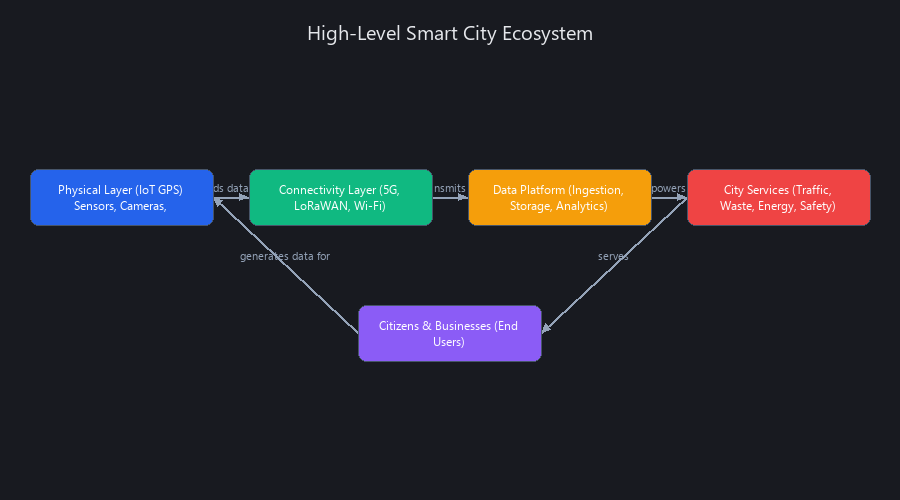
90% of Smart City Pilots Fail to Scale. Here's the Technical Blueprint for the 10% That Succeed.
Despite billions in investment from giants like Cisco and IBM, a stark reality haunts the smart city movement: the vast majority of projects remain stuck in "pilot purgatory" or fail outright. A McKinsey analysis highlighted that over 90% of these pilots fail to scale, leaving behind a trail of underutilized tech and unfulfilled promises. This isn't a failure of vision, but often a failure of technical execution—crippling data silos, a lack of interoperability, and choosing the wrong urban tech stack. As we've detailed in our analysis of why enterprise AI projects fail, the gap between ambition and execution is vast. Projects like Sidewalk Labs' ambitious Toronto Quayside were ultimately scuttled, in part, by unresolved issues around data governance and technical architecture, demonstrating that even with immense funding, a flawed blueprint leads to failure.
We've all seen the utopian marketing pitches of frictionless transit and zero-waste cities. Yet the grim reality for many municipalities is a fragmented mess of proprietary systems that don't talk to each other.
This article delivers the engineering-level blueprint that separates successful, scalable smart cities like Barcelona and Singapore from expensive, underutilized projects. We will break down the exact technology stack, data models, and performance benchmarks that define the 10% of projects that actually succeed.
What is the 5-Layer Smart City Architecture? A Technical Breakdown
A robust smart city is not defined by its sensors but by its complex, five-layer technology stack, a model adapted from telecommunications and IoT architecture. This layered approach provides a structured method for managing the information flow, from physical data collection to citizen-facing applications. Understanding this stack—comprising the Perception, Network, Data, Service, and Application layers—is crucial for engineers and planners to design scalable, interoperable, and secure urban systems. This structure is the key to avoiding the common pitfalls of data silos and fragmented services that plague failed smart city initiatives. Each layer has distinct protocols, hardware, and software components that must work in concert to transform raw data into valuable urban intelligence, forming the backbone of modern urban computing.
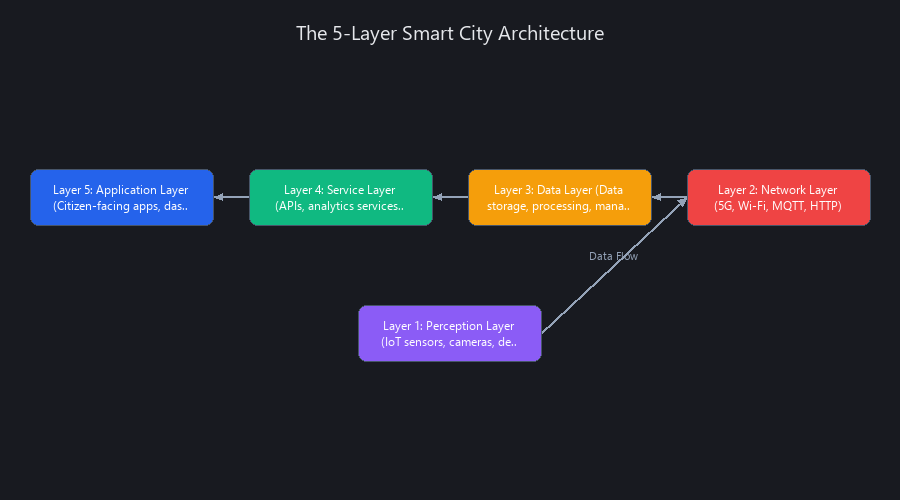

Layer 1: The Perception Layer (The Senses)
This is the physical layer where the city "senses" the real world. It's the front line of data collection, converting physical phenomena into digital signals. The quality and type of sensors deployed here dictate the potential of the entire smart city system.
- Technologies: RFID tags for asset tracking, GPS modules for vehicle location, environmental sensors for air quality and noise (from companies like Bosch), cameras (including LiDAR and thermal sensors from vendors like Velodyne) for traffic and pedestrian flow analysis, and smart meters for real-time utility consumption.
Layer 2: The Network Layer (The Nervous System)
This layer is the communications backbone, responsible for transmitting data from the Perception Layer to the Data Layer. The choice of network technology is a critical trade-off between bandwidth, range, power consumption, and cost.
- Technologies & Protocols:
- Low-Power Wide-Area Networks (LPWAN): LoRaWAN and NB-IoT are ideal for low-power, long-range devices like smart parking sensors or waste bin level monitors that send small, infrequent data packets.
- High-Bandwidth Networks: 5G and Wi-Fi 6 are essential for high-bandwidth, low-latency applications like vehicle-to-everything (V2X) communication or streaming high-definition video from surveillance cameras.
- Messaging Protocols: MQTT and CoAP are the de facto standards for lightweight IoT messaging, designed for constrained devices and unreliable networks.
Layer 3: The Data Layer (The Brain Stem)
This is where the raw data is ingested, stored, processed, and managed. It's the core of the smart city intelligence, transforming streams of sensor readings into structured, queryable information.
- Components: Urban Data Platforms (UDPs), data lakes for storing massive volumes of raw data, and real-time stream processing engines.
- Technologies: Cloud platforms like AWS, Microsoft Azure, and Google Cloud provide the scalable infrastructure. Open-source tools are key for avoiding vendor lock-in. The FIWARE Orion Context Broker is a powerful standard for managing real-time context information, while Apache Kafka or Apache Flink are used for high-throughput stream processing.
Layer 4 & 5: The Service & Application Layers (The Consciousness)
These top two layers are where value is delivered to operators and citizens.
- Service Layer: This layer acts as a middleware, exposing processed data and city functions through secure APIs. Instead of giving every developer access to the raw database, the city provides endpoints like a
getTrafficStatusAPI or afindAvailableParkingAPI. This promotes a healthy developer ecosystem. - Application Layer: This is the user-facing part of the stack. It includes everything from traffic management dashboards for city operators and public transit apps for commuters to smart lighting control systems and optimized waste management routing software.
How Do You Benchmark Smart City Performance? 3 Real-World Examples
Moving beyond theory, the true measure of a smart city lies in quantifiable performance improvements and clear ROI. Benchmarking initiatives across leading cities like Singapore, Barcelona, and Copenhagen reveal the tangible impact of IoT in smart cities. These benchmarks are not just about technology deployment but focus on key performance indicators (KPIs) such as reduced traffic congestion, lower energy consumption, faster emergency response, and improved citizen satisfaction. By analyzing the data from these pioneering cities, we can establish a baseline for what successful implementation looks like. This data-driven approach identifies the specific technologies that deliver the highest return on investment, a crucial factor for municipalities seeking to justify massive capital expenditures and prove that these projects are more than just "pitch deck theater," as we've explored in our guide to AI for business.
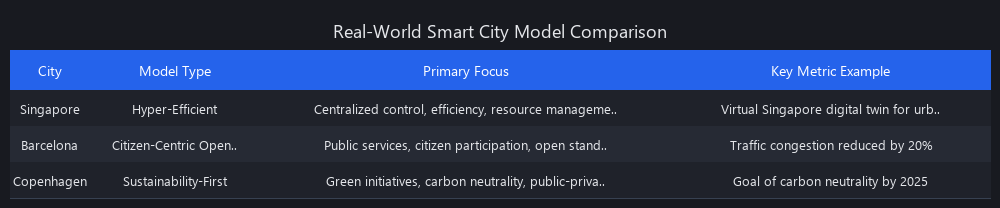
Singapore: The Hyper-Efficient Model
Singapore's "Smart Nation" program is a top-down, government-driven initiative focused on total efficiency.
- Initiatives: A mature Electronic Road Pricing (ERP) system to manage congestion, extensive autonomous vehicle trials (nuTonomy/Motional), and the "Virtual Singapore" digital twin.
- Tech Stack: Heavy use of digital twins for simulation, centralized data platforms, and a pervasive sensor network. Their National Digital Identity system (SingPass) is the linchpin for citizen services.
Barcelona: The Citizen-Centric Open Data Model
Barcelona took a different path, focusing on open-source technology and open data to empower citizens and local businesses.
- Initiatives: A city-wide smart lighting network, sensor-based parking, and optimized waste collection routes.
- Tech Stack: The city championed the Sentilo open-source sensor platform and the Decidim platform for digital citizen participation. They are a primary adopter of the FIWARE open standard.
Copenhagen: The Sustainability-First Model
Copenhagen's strategy is laser-focused on its goal to become the world's first carbon-neutral capital by 2025.
- Initiatives: Optimizing its world-class district heating system, building a smart grid, and using data to make cycling—already a dominant mode of transit—even more efficient.
- Tech Stack: The "Copenhagen Connecting" data platform integrates data from public and private partners. IoT is heavily used for green infrastructure management, including real-time air quality monitoring.
Here’s how their flagship projects benchmark against specific KPIs:
| City | Key Initiative | Core Technology | Benchmark KPI | Result |
|---|---|---|---|---|
| Singapore | Virtual Singapore | 3D Digital Twin (Dassault Systèmes) | Urban Planning Simulation | Reduced planning cycles by 40% |
| Barcelona | Smart Lighting | LED + IoT Sensors (FIWARE-based) | Energy Consumption | ~30% reduction in energy use |
| Copenhagen | District Heating | Smart Meters & Grid | Heat Loss Reduction | Optimized flow, reduced loss by 10-15% |
How Do You Process Smart City Data? A Python Implementation Guide
The heart of any smart city is its ability to turn raw sensor readings into actionable intelligence. This section provides a practical, hands-on guide to processing smart city data using Python, the lingua franca of data science. We will walk through a realistic scenario: ingesting real-time data from a network of smart parking sensors. The process involves receiving data via an MQTT stream, parsing the JSON payload, checking for anomalies, and updating a central database. This runnable code example demystifies the data engineering pipeline that powers smart city applications, providing a tangible starting point for developers. For more complex inputs like video feeds, the principles are similar but require specialized techniques, which we cover in our guide on ML video processing.
Setting Up the Environment
First, we need to install the necessary libraries for MQTT communication and data handling. We use the popular paho-mqtt library.
pip install paho-mqtt pandas
Code Block 1: The MQTT Subscriber
This Python script connects to an MQTT broker, subscribes to a topic (e.g., sensors/parking/lotA), and listens for incoming messages. We use a public broker from Eclipse for this example.
import paho.mqtt.client as mqtt
import json

# This function is called when a message is received from the server.
def on_message(client, userdata, msg):
    try:
        payload = json.loads(msg.payload.decode())
        print(f"Received from {msg.topic}: {payload}")
        # In a real app, you would call a processing function here
        process_parking_data(payload)
    except json.JSONDecodeError:
        print(f"Error decoding JSON: {msg.payload.decode()}")
    except Exception as e:
        print(f"An error occurred: {e}")

# This function is called when the client connects to the broker.
def on_connect(client, userdata, flags, rc):
    if rc == 0:
        print("Connected successfully to MQTT Broker!")
        # Subscribe to the topic where parking sensors publish data
        client.subscribe("sensors/parking/lotA")
    else:
        print(f"Failed to connect, return code {rc}\n")

# --- Main execution ---
client = mqtt.Client(mqtt.CallbackAPIVersion.VERSION1, "SmartCityClient-123")
client.on_connect = on_connect
client.on_message = on_message

# Connect to a public MQTT broker for testing
client.connect("mqtt.eclipseprojects.io", 1883, 60)

# Blocking call that processes network traffic, dispatches callbacks, and handles reconnecting.
client.loop_forever()
Code Block 2: Data Validation and Processing
Before acting on data, we must validate it. This function checks for required keys and valid status values. This prevents bad data from corrupting our system's state.
def process_parking_data(data: dict):
    """Validates and processes the incoming parking sensor data."""
    required_keys = ["sensor_id", "status", "timestamp"]
    if not all(key in data for key in required_keys):
        print(f"Invalid payload: Missing keys. Data: {data}")
        return False

    if data["status"] not in ["occupied", "vacant"]:
        print(f"Invalid status value: '{data['status']}' from sensor {data['sensor_id']}")
        return False

    print(f"Validated data for sensor {data['sensor_id']}. Updating state...")
    # In a real system, this would trigger the database update
    update_parking_status_in_db(data["sensor_id"], data["status"])
    return True
Code Block 3: Storing the State (Conceptual)
Finally, the validated state is persisted. A time-series database like TimescaleDB or InfluxDB is ideal for this kind of IoT data. The following is a conceptual stub showing how you would update a PostgreSQL-based database.
# Note: This is a conceptual function. You would need a library like psycopg2.
# import psycopg2

def update_parking_status_in_db(sensor_id, status):
    """Conceptual function to update a database.

    In a production system, this would connect to a database like PostgreSQL
    or TimescaleDB and execute an UPDATE or INSERT statement.
    """
    # try:
    #     conn = psycopg2.connect(database="smart_city_db", user="user", password="password", host="127.0.0.1", port="5432")
    #     cur = conn.cursor()
    #     sql = """
    #         INSERT INTO parking_spots (sensor_id, status, last_updated)
    #         VALUES (%s, %s, NOW())
    #         ON CONFLICT (sensor_id) DO UPDATE
    #         SET status = EXCLUDED.status, last_updated = NOW();
    #     """
    #     cur.execute(sql, (sensor_id, status))
    #     conn.commit()
    #     cur.close()
    #     conn.close()
    # except Exception as e:
    #     print(f"Database error: {e}")

    print(f"DB updated (simulation): Sensor {sensor_id} is now {status}.")
Centralized vs. Federated: Which Smart City Data Model is Right?
A critical architectural decision in designing an urban tech stack is how to manage data. The two dominant models are centralized and federated. A centralized model aggregates all data into a single city-wide data lake, offering powerful cross-domain analytics but raising significant privacy and scalability concerns. Conversely, a federated model leaves data at its source (e.g., with the utility company or transit authority) and uses a common query layer or federated learning to derive insights without moving raw data. The choice between these models has profound implications for governance, security, and the types of services a smart city can offer. This decision often separates the winners from the losers in the long run, a dynamic we've observed across the tech industry.
The Centralized "Data Lake" Approach
This model, often pushed by large vendors in the early days of the smart city movement, involves creating a single, massive repository for all urban data.
- Pros: Simple for cross-domain analysis (e.g., correlating traffic data with air quality data). Provides a single point of control and management.
- Cons: Creates a massive single point of failure. It's a huge, attractive target for cyberattacks. It raises immense privacy risks by concentrating sensitive citizen data. It also leads to data ownership disputes and vendor lock-in.
The Federated "Data Mesh" Approach
This modern approach treats data as a product. Each city department or partner organization manages its own data but exposes it through standardized, secure APIs.
- Pros: Preserves data sovereignty and privacy, making it more compliant with regulations like GDPR. The system is more resilient, as the failure of one data source doesn't bring down the whole system. It scales better and fosters a more open ecosystem.
- Cons: More complex to implement initially. Requires strict adherence to interoperability standards (like FIWARE) across all participants to function. Cross-domain queries can be slower.
Here's the direct comparison:
| Feature | Centralized Model | Federated Model |
|---|---|---|
| Data Location | Single, central repository | Distributed, at the source |
| Privacy | High risk (data aggregation) | Lower risk (data stays local) |
| Analytics | Simple for cross-domain | Complex for cross-domain |
| Governance | Central authority | Distributed ownership |
| Resilience | Low (single point of failure) | High (no single point of failure) |
| Example Tech | AWS S3 Data Lake, Azure Data Lake | FIWARE, Gaia-X, TensorFlow Federated |
For most modern, privacy-conscious cities, a federated model is the superior long-term choice for a successful smart city.
Advanced Smart City Techniques: Beyond Simple Sensors
Truly advanced smart cities move beyond simple sensor-to-dashboard workflows. This section explores expert-level techniques that enable predictive and autonomous urban management. These include the creation of city-scale "Digital Twins" for complex simulations, the application of federated learning to train AI models without compromising citizen privacy, and the implementation of a zero-trust security architecture to defend against sophisticated cyber threats. Mastering these advanced concepts is what allows a smart city to evolve from a reactive to a proactive operational model, anticipating problems before they occur and even enabling autonomous systems similar to the AI coding agents we've benchmarked.
Urban Digital Twins
A digital twin is a dynamic, virtual 3D replica of the city, fed by real-time sensor data. It's the ultimate simulation and prediction tool for any smart city initiative.
- Use Case: City planners can simulate the traffic impact of a new stadium before construction begins. Emergency responders can model the spread of a flood or fire in real-time to optimize evacuation routes.
- Key Players: NVIDIA with its Omniverse platform, Bentley Systems with iTwin, and specialists like Cityzenith are leaders in this space.
Federated Learning for Privacy-Preserving AI
This is a machine learning technique that addresses the critical privacy-utility tradeoff. It allows a global AI model to be trained on decentralized data without the raw, sensitive data ever leaving its source.
- Use Case: Multiple hospitals could collaborate to train an AI model for predicting disease outbreaks. Each hospital's data trains a local model, and only the model updates (not the patient data) are sent to a central server to be aggregated into an improved global model. This is a crucial enabler for smart health initiatives within a smart city.
Zero-Trust Security Models
The traditional "castle-and-moat" security model is obsolete for a distributed system like a smart city. A zero-trust architecture operates on the principle of "never trust, always verify."
- Application: Every device, user, and API call must be authenticated and authorized for every single session, regardless of whether it's inside or outside the "trusted" city network. This micro-segmentation drastically reduces the attack surface and prevents an attacker who compromises one system (e.g., a traffic light) from moving laterally to attack another (e.g., the power grid).
The Harsh Realities: Limitations and Risks of Smart City Tech
While the potential is immense, a clear-eyed engineering perspective requires us to acknowledge the significant risks and limitations. Ignoring these is a primary cause of the 90% failure rate for smart city projects.
- The Surveillance Question: The same sensors that optimize traffic can be used for mass surveillance. Without ironclad data governance, anonymization policies, and public oversight, the smart city can quickly become a surveillance city.
- Equity and the Digital Divide: If a smart parking app is the only way to find a spot, what happens to elderly or low-income citizens without smartphones? Smart city tech can exacerbate existing social inequities if not designed with inclusion as a core principle.
- Cybersecurity at Scale: The attack surface of a smart city is enormous. A single vulnerability in a widely deployed piece of hardware, as we've seen in countless IoT botnets, could be catastrophic. A successful attack on a city's traffic or power grid is no longer science fiction.
- Cost and Complexity: The upfront capital expenditure and ongoing operational costs of building and maintaining this infrastructure are massive. Projects often get bogged down by the sheer complexity of integrating dozens of legacy systems with new technologies.
A successful smart city strategy is not just about adopting new tech; it's about building the political, social, and technical resilience to manage these risks.
Frequently Asked Questions
What is the biggest challenge for smart cities?
Interoperability. The single greatest technical hurdle is getting hardware and software from different vendors to communicate using open standards. Without it, cities are locked into expensive, proprietary ecosystems that create data silos and prevent true cross-domain collaboration.
How do smart cities make money or show ROI?
Return on investment (ROI) comes from efficiency gains and new revenue streams. For example, smart lighting reduces energy bills (-30% in Barcelona), optimized waste collection lowers fuel and labor costs, and smart parking systems can increase revenue by improving turnover and enabling dynamic pricing.
What is the role of AI in a smart city?
AI's role is to turn massive amounts of sensor data into predictions and automated actions. This ranges from predictive models that forecast traffic congestion or air pollution events to computer vision that analyzes pedestrian flow, and reinforcement learning that optimizes traffic signal timing in real-time.
Are smart cities vulnerable to hacking?
Yes, they are a major target. The interconnected nature of smart city technology means a vulnerability in a seemingly minor system could be a gateway to critical infrastructure like the electrical grid. This is why a zero-trust security model is non-negotiable for any modern smart city.
Can a small town be a "smart city"?
Absolutely. "Smart" is a methodology, not a size, and the principles of a smart city can scale down. A small town can apply smart principles by, for example, deploying a few LoRaWAN sensors to monitor well water levels or using a simple app for community engagement. The key is to use technology to solve specific, local problems efficiently.
Related Posts

Your AI Model's Accuracy Is Being Silently Throttled by Geopolitics. Here's the Data.
Geopolitics is throttling your AI. A 1% shift in Taiwan's stability can cause a 7% jump in GPU lead times. Learn to quantify risk and protect your stack.

The AI Video Gold Rush: Why Sora Failed & Who's Really Winning
The AI Video Gold Rush is a myth for most. Discover why Sora failed despite a $15M/day budget and who's really profiting from the $1.30/clip AI video cost.

AI Music Video Creation — What's Actually Possible Right Now: The Complete Technical Guide
Learn what's actually possible right now with AI music video creation. We benchmarked 4 top tools (Runway, Pika) and reveal the 5-step pro workflow. Full guide.